PL/EN Instructions for a Multilingual Barber Team
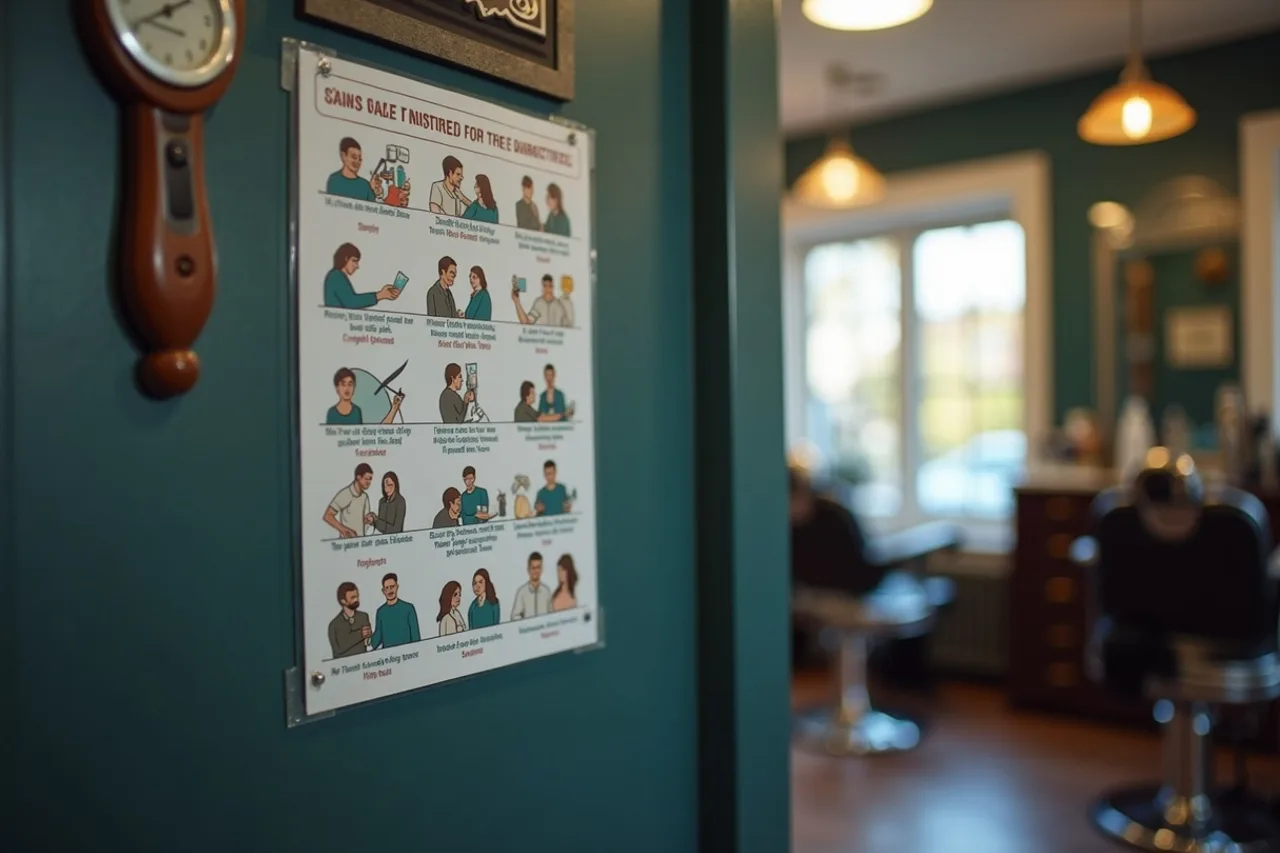
At your chairs you have Paweł from Poland, Denys from Ukraine and Niko from Georgia. Each of them cuts brilliantly.
At your chairs you have Paweł from Poland, Denys from Ukraine and Niko from Georgia. Each of them cuts brilliantly. But when the inspector asks about disinfection, one says one thing, the second another, and the third doesn't understand the question. Not because they're careless — they simply never got the same rules in a language they understand.
A multilingual team is the norm in barbershops today. PL/EN instructions are not a luxury — they are a condition for everyone doing the same thing and for the documentation to make sense during an inspection.
Barbers from Ukraine, Georgia, Belarus and other countries bring great skills. But the skill of cutting is one thing, and knowing your sanitary procedures is another. If the rules exist only in Polish, part of the team works "on a hunch" — and a hunch, with a razor against a client's skin, can be unreliable. Bilingual documentation levels the playing field.
Why one language is not enough
An instruction in Polish signed by someone who barely speaks Polish is a fiction, both legally and in practice:
- Legally — health-and-safety training and procedures must be in a language the employee understands. Otherwise the signature does not protect the employer.
- In practice — an employee who doesn't understand the instruction does it "their own way". And "their own way", with a blade against a client's skin, is a risk.
- During an inspection — the inspector asks the employee, not the binder. If the employee can't answer, all the documentation drops in the assessment.
Which instructions have to be bilingual
You don't have to translate everything. Focus on what the employee does with their hands and what is critical for safety.
| Instruction | PL/EN priority |
|---|---|
| Hygiene and hand washing | High |
| Disinfecting tools between clients | High |
| Sterilisation (autoclave) | High |
| Handling a cut to a client | High |
| Cleaning the station and the premises | Medium |
| Handling complaints / the client's rights | Medium |
Pictograms — a universal language
Not every employee reads English fluently. That is why, alongside the PL/EN text, it's worth providing an image:
- A hand-washing icon by the basin.
- A disinfection icon at the tool-disinfection station.
- A "STOP / red" mark on tools that have had contact with blood and are going for sterilisation.
- A first-aid-kit pictogram on its door.
An image works without translation. Text explains the detail, a pictogram reminds you of the rule.
10 phrases everyone must know from day one
Regardless of the language, a few Polish terms should be understood from Day 1 — because they come up during the rush and during an incident:
- "Dezynfekcja" (disinfection), "sterylizacja" (sterilisation), "jednorazowe" (single-use).
- "Skaleczenie" (a cut), "apteczka" (first-aid kit), "krew" (blood).
- "Myję ręce" (I'm washing my hands), "czyste" (clean), "brudne" (dirty), "stop".
This isn't a language course — it's safety. Weave the learning process into onboarding a barber in 7 days, and reinforce the procedures themselves during sanitary training for the team.
How to roll this out without chaos
- One carrier at the station — a laminated PL/EN sheet + a pictogram at every key point (basin, disinfection station, autoclave).
- A buddy who speaks the new hire's language — translating in the first days, then switching to Polish.
- Showing, not telling — 80% of onboarding a non-Polish-speaking employee is demonstration. You say less, you show more.
- A signature under the version they understand — the employee signs the instruction in their own language, not "on trust".
Where to hang the instructions so someone actually looks at them
An instruction in a binder is a dead instruction. It has to be where the task is performed:
- By the basin — hand washing and disinfection, technique, the moments.
- At the disinfection station — product, concentration, contact time for clippers and combs.
- At the autoclave — the cycle sequence, packing, the register entry.
- On the first-aid-kit door — a shortened procedure for a cut.
A laminated A4 sheet costs pennies, yet reminds you of the rule at exactly the moment it's needed. That turns an instruction from "a document for the inspection" into "a working tool".
Common mistakes with multilingual documentation
- Machine translation without checking — a dictionary translator can change the meaning of a sanitary instruction. It's worth having key sentences checked by someone who knows the language.
- A signature under the Polish version "for the record" — if the employee doesn't understand Polish, their signature under a Polish instruction confirms nothing.
- Too much text — the more words, the less anyone reads. Keep it short, specific, with a pictogram.
- No updates — you change the disinfectant, but the instruction still refers to the old one. You update the PL and EN versions together.
GDPR and documents in multiple languages
The GDPR privacy notice and consents (e.g. to use someone's image on social media) should also be understandable to the employee and the client. If you serve non-Polish-speaking clients, it's worth having an EN version of the data-processing consent and the visit terms. A signature under a notice the client doesn't understand is just as weak as an employee's signature under an instruction they don't understand — it does not confirm informed consent.
Updating the instructions — when and how
An instruction is a living document, not an exhibit. You update the PL and EN versions together, every time the real process changes:
- A change of disinfectant — a new solution means a different concentration and contact time. The instruction has to keep up.
- New equipment — a different autoclave model, a new set of clippers. Update the operating description in both languages.
- A remark from an inspection — if an inspector flagged something, fix the procedure and train the team on the new version.
- Staff turnover — with new employees it's worth checking whether the instructions are still clear and complete.
It's worth marking the date of the last update on the document. That shows it's a living system, not a sheet from five years ago.
A practical order for rolling out bilingual instructions
- List the critical procedures (hygiene, disinfection, sterilisation, a cut).
- Translate them into EN and have them checked by someone who knows the language.
- Add pictograms at the key points.
- Hang the laminated versions at the stations.
- Go through them with the team and collect signatures under the version they understand.
Frequently asked questions
Does the law require instructions in the employee's language?
Health-and-safety training and safety procedures must be conveyed in a way the employee understands. If they barely speak Polish, the documentation and training should be in their language or with a translation — otherwise the signature does not confirm actual knowledge of the rules.
Are pictograms alone enough instead of text?
No. Pictograms are great for reminding you of a rule and they work at the pace of the job, but they won't replace a full instruction or a signed declaration. The best set is PL/EN text plus a pictogram at the key point.
In how many languages should the instructions realistically be made?
PL plus EN covers most teams. EN is a practical common denominator for employees from Ukraine, Georgia and other countries. For the most important rules, add pictograms so they work regardless of language level.
Who translates the documents — do I need a sworn translator?
For internal sanitary and health-and-safety instructions you don't need a sworn translator — a correct, understandable translation is enough. A sworn translator is sometimes needed for official documents, not for workstation instructions.
Have a team speaking several languages and want everyone to do the same thing? BarberReady gives you ready-made PL/EN instructions with pictograms: hygiene, disinfection, sterilisation, handling a cut, and GDPR clauses. One standard for the whole crew, ready to hang at the station.