Sterilisation in the Field for a Mobile Barber
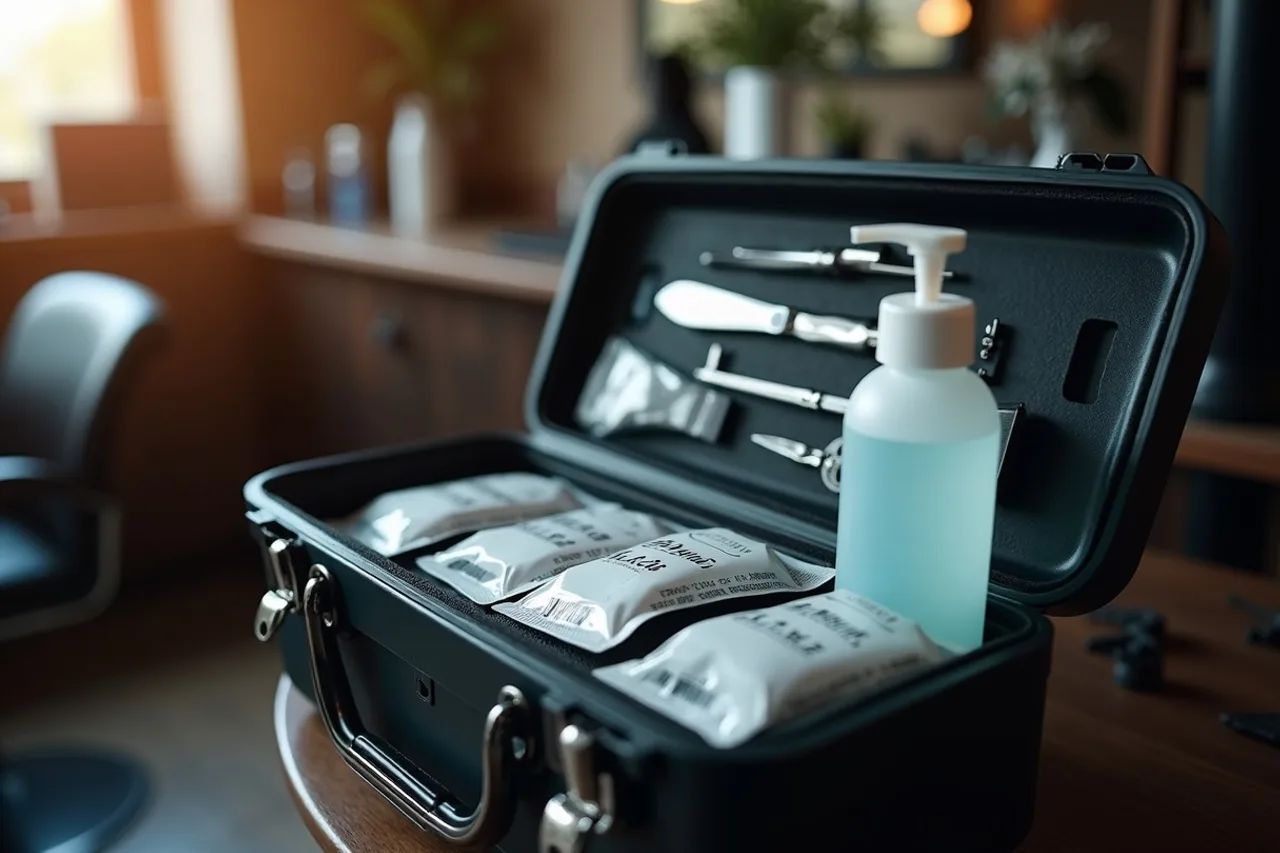
In the salon you have an autoclave on the counter. In the field you have a backpack and half an hour between clients.
In the salon you have an autoclave on the counter. In the field you have a backpack and half an hour between clients. The question that keeps every mobile barber up at night: how do you ensure your tools are sterile at the client's when you can't fit an autoclave into a backpack? The answer is simpler than it seems — but it takes a shift in thinking from "I sterilise on the spot" to "I bring them already sterile".
Sterilisation in the field is logistics, not improvisation. Below is a system that works at the client's, at a wedding and at an event.
The most important change is in your head: stop thinking "I have to sterilise the tools on the spot" and start thinking "I bring the tools already sterile and I have enough of them for all the clients". The rest is organisation: an adequate spare, good packing and order between clean and dirty. Once you set that up, working in the field is just as safe as in the salon — the chair just stands somewhere else.
Disinfection is not sterilisation — the key difference
These are two different things, and confusing them is the most common mistake:
- Disinfection — reduces micro-organisms. You do it between clients: clippers, combs, surfaces. You can do it in the field with a solution or spray.
- Sterilisation — destroys all forms of micro-organisms, including spores. It requires an autoclave (steam under pressure). It applies to tools that come into contact with blood.
In the field you disinfect, and you sterilise at the base — and you bring the finished, packed tools with you.
The "sterile sets in pouches" model
The key to sterility in the field: prepare the tools in advance at the salon and take as many of them as you have clients.
- You sterilise the tools in the autoclave at the base.
- You pack them in sterilisation pouches (with an indicator and a date).
- You take one set per client + a spare.
- You open the pouch only at the client — that's the proof of sterility.
Each client gets their own sterile set. A used tool you set aside in the "for sterilisation" container and carry back to the base.
What you do between clients in the field
| Tool / item | Action in the field |
|---|---|
| Shaving blade | Single-use — new for each client |
| Hair clippers | Disinfection + swapping the blade/guard |
| Scissors, combs | Disinfection or a sterile set from a pouch |
| Tools with blood contact | Set aside for sterilisation at the base — don't reuse |
| Neck strip, cape, towel | Single-use — new for each |
Equipping a mobile disinfection station
- A tool disinfectant with virucidal action (check the safety data sheet).
- A container for the working solution, with a lid.
- Two labelled containers: "clean / ready" and "for sterilisation".
- Single-use gloves for handling dirty tools.
- A hard-walled container for used blades.
Sterilisation documentation — proof that you do it
Sanepid (the sanitary inspectorate) will not take your word for it. Keep a simple register:
- Date and sterilisation cycle, the result of the check (indicator).
- Expiry date of the sterile pouches.
- Safety data sheets for the disinfectants used.
This is the same standard a fixed salon requires — more on the mobile requirements in the sanitary requirements for a mobile barber, and on the pace at an event in a barber at events and weddings.
Transporting tools — the clean side and the dirty side
In the field, tools travel there and back. Without a split into "clean" and "dirty" you risk a used clipper coming into contact with a sterile set. Organise the transport so that these two worlds don't mix:
- A separate container for sterile pouches — closed, dry, not opened until use.
- A separate, sealed "for sterilisation" container — used tools go here and travel to the base.
- A hard-walled container for used blades — safe disposal, zero risk of a needlestick-type injury.
Back at the base: tools from the "for sterilisation" container you wash, pack and run through the autoclave. Only then do they return to circulation as sterile sets for the next trip.
How much doing this properly costs
Barbers often think that sterility in the field is a big expense. In practice it's mainly a matter of the spare:
- A few extra tool sets, so you don't have to sterilise "right now".
- Sterilisation pouches with an indicator — pennies apiece.
- Single-use blades, neck strips and capes — you include them in the price of the service.
That's cheaper than a single claim for an infection or the loss of your reputation after a non-sterile razor. Sterility is a cost included in the price of a professional service, not a premium option.
The most common mistakes with sterilisation in the field
- "I'll wipe it with alcohol and that'll do" — a wipe is not disinfection, and certainly not sterilisation.
- Reusing a shaving blade — the blade is single-use, full stop.
- No spare tools — one set for five clients forces you to cut corners on procedures.
- Pouches with no date and no indicator — you have no proof the tool is sterile.
The work rhythm at the base — the tool cycle
Sterility in the field starts at the base and ends there. Set up a steady cycle so nothing slips through:
- Return from the trip — used tools go from the "for sterilisation" container to washing.
- Washing and drying — you remove the dirt, because the autoclave won't replace washing.
- Packing in pouches — with an indicator and a date.
- A cycle in the autoclave — with a register entry and effectiveness monitoring.
- Setting aside among the "ready" ones — the sets wait for the next trip.
The same cycle every time means you never happen to grab a non-sterile tool "because I was in a hurry". The system watches over it for you.
Sterility as an argument for the client
The client can't see your base, but they can see you open the pouch in front of them. That's the strongest proof the tool is sterile — freshly unwrapped, with a visible date. In times when clients increasingly ask about hygiene, visible sterilisation is not only an obligation but also an advantage. A barber who shows a sterile set builds trust faster than one who "wipes the clippers and assures you it's clean".
Frequently asked questions
Can I sterilise tools at the client's?
In practice no — an autoclave requires a support base and time. The model for a mobile barber is sterilisation at the base, packing the tools in pouches and bringing them ready. At the client's you carry out disinfection and swap the single-use items.
Is a portable UV steriliser enough?
A UV lamp is not equivalent to steam sterilisation in an autoclave and does not ensure the sterility of tools that come into contact with blood. It can support hygiene, but it doesn't replace an autoclave or single-use items. For critical tools use sterilisation at the base or single-use elements.
How many sterile sets should I take on a trip?
As many as you have booked clients, plus a spare for 1–2 extra. You plan this before setting off, because in the field you won't sterilise a new set on the spot.
How long does a pouch keep tools sterile?
It depends on the type of packaging and the storage conditions — which is why every pouch has a sterilisation date and an expiry date. A damaged, damp or opened pouch loses its sterile status and the tool goes back for re-sterilisation.
Want to ensure your tools are sterile outside the salon too? BarberReady gives you a ready-made system for working in the field: disinfection and sterilisation procedures, a cycle register, an equipment list for a mobile station, and rules for packing and storing sterile tools. Sterility you can defend during an inspection.