Disinfecting the Barber Chair and Surfaces
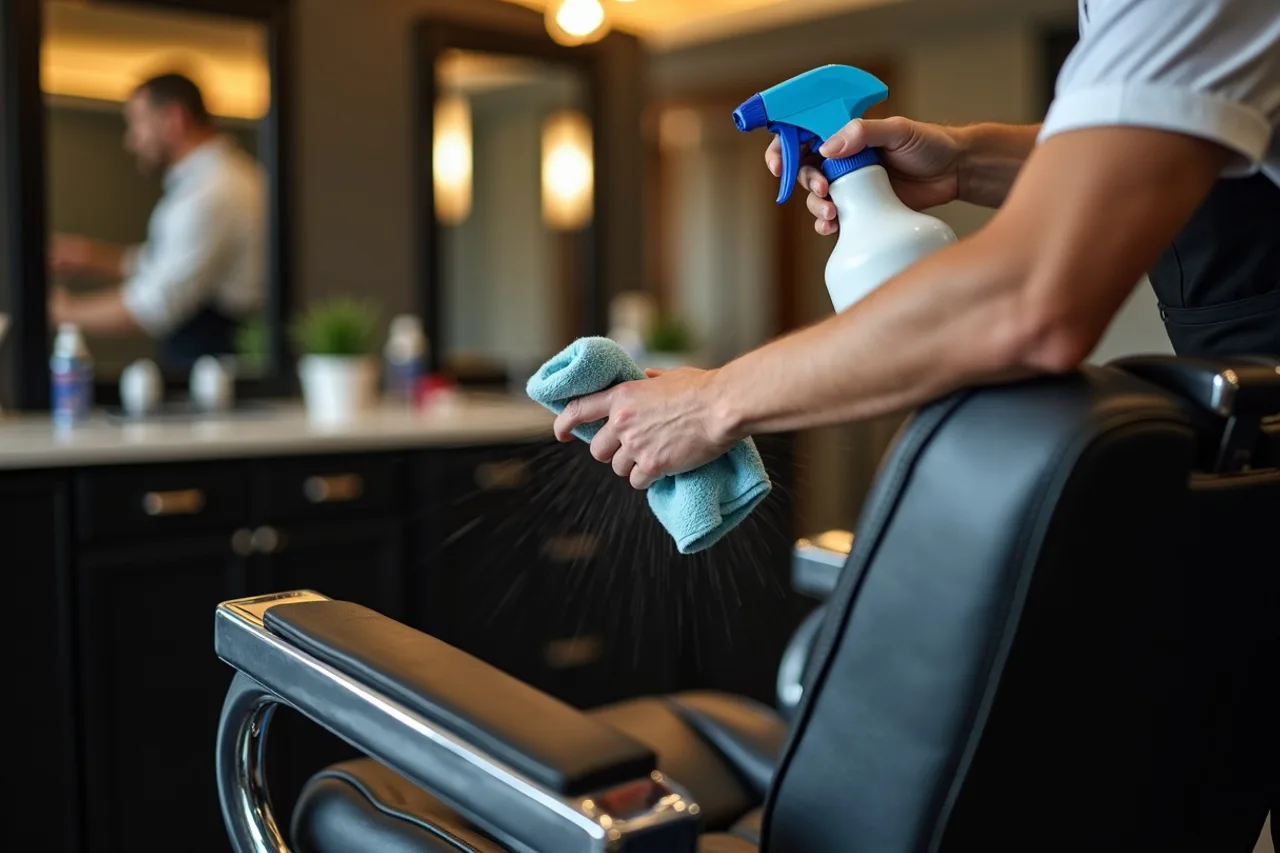
Friday, peak hours. A client gets up from the chair, the next one is already waiting. The barber quickly shakes the hair off the cape and invites the next person…
Friday, peak hours. A client gets up from the chair, the next one is already waiting. The barber quickly shakes the hair off the cape and invites the next person in. Nobody wiped down the armrests, the headrest or the counter. And it is precisely this moment – invisible to the client, obvious to the inspector – that decides whether you have a system or just good intentions. Disinfecting the chair and surfaces in a barbershop is not cleaning "when there's time". It is a procedure with specific moments, products and a record. This article shows how to set it up so that it works during a full schedule.
What the client actually touches – and what needs disinfecting
Surfaces in a salon fall into those that have direct contact with the client's skin and those touched by staff. The first need disinfecting after every client, the second – regularly during the day. The Regulation of the Minister of Health of 17 February 2004 on sanitary requirements for hairdressing establishments requires surfaces and equipment to be kept clean and disinfected.
- After every client: the chair (armrests, headrest, backrest), the station counter, any tool rack/shelf within reach
- Every few clients / every hour: dryer handles, product bottles, switches, mirrors touched by hand
- After each shift: the hair-washing basin, the floor around the station, door handles, the card terminal
Disinfecting the chair – how to do it properly
Leather or faux-leather chair upholstery is the most common point of neglect. It looks clean, so the barber decides "by eye" that there is no need. Mistake. Hair, shed skin and sweat remain on the surface after every client.
The procedure is simple:
- remove hair remnants (a brush, compressed air or a cloth)
- spray the armrests, headrest and backrest with a surface product
- wipe with a single-use cloth or a clean cloth with controlled laundering
- wait the product's contact time given on the label (usually 1–5 minutes)
Do not use neat alcohol on faux leather every day – it dries it out and it cracks. Choose a product intended for surfaces and upholstery. We write about how to choose products in the article disinfectants in a barbershop – how to choose.
Capes, gowns and neck strips
A cape is a barrier between the hair and the client's clothing – but it itself touches their neck and nape. Two rules:
- use a single-use paper neck strip (collar) under the cape – one per client
- launder cloth capes regularly; on visible soiling – immediately
The same applies to towels, which circulate non-stop in a barbershop. We break down the rules for laundering and storage in the article towels and linen – laundering and storage.
Frequency – a table worth hanging up
| Item | Frequency | Product |
|---|---|---|
| Chair (armrests, headrest) | after every client | surface product |
| Station counter | after every client | surface product |
| Neck strip | single-use, one per client | replacement |
| Mirrors, handles | every few clients | surface product |
| Basin, floor | after the shift / at the end of the day | surface product + washing |
| Terminal, door handles | at least 2x daily | disinfectant wipes |
Contact time – the most common mistake
Spray and wipe straight away is not disinfection. Every product has a contact time given on the label – the period it must remain on the surface to take effect. If you write "wiped" but you wiped after two seconds, all you did was spread the liquid around. Leave the product for the stated time, then wipe dry. This one thing separates real disinfection from theatre.
How to document it
Surface disinfection is not a one-off action before an inspection, but a rhythm built into the working day. The key is to build a habit that survives peak hours: shake off, spray, wipe, next. Once it becomes automatic, it stops being a burden – just as you don't think about washing your hands, you don't think about wiping down the chair.
The inspector does not stand over you all day. They check whether you have a procedure and whether a record is kept. At a minimum:
- A surface disinfection procedure – what, with what, how often
- A disinfection register – entries confirming it was done (date, scope, signature)
- Product safety data sheets – available in the salon
We discuss a register template in the article disinfection and sterilisation register – a template. You do not have to record every wipe – confirming cycles is enough (e.g. station disinfection each shift, the basin at the end of the day).
Floor, basin and shared areas
Surfaces are not just the chair. The floor around the station collects cut hair all day long – this is not only a matter of appearance but of hygiene. Sweep after every client and wash with a product at the end of the shift. The hair-washing basin has direct contact with the client's skin and hair, so wipe it between clients and disinfect it at the end of the day.
Don't forget the areas that are easy to overlook because the client "doesn't see" them:
- handles and switches on dryers, clippers, lamps
- bottles and containers of cosmetics that you touch with a dirty hand
- door handles, the card terminal, the reception counter
- the waiting area: side table, remote, coffee machine – if you offer coffee
It is precisely these "invisible" points that show the inspector whether disinfection is a system or just a gesture at the chair.
The most common mistakes at the station
Four traps that even a well-kept salon falls into:
- Wiping straight after spraying – without contact time it is just spreading the liquid, not disinfection
- The same cloth all day – a dirty cloth spreads contamination; use single-use ones or launder them under control
- Skipping the headrest – it is the most frequently neglected part of the chair, yet it has contact with hair and the nape
- Hand product used on surfaces – that is a different product for a different purpose; do not swap them
Each of these mistakes is minor on its own. Together they add up to a picture of a salon that "cleans" but does not disinfect – and the inspector sees that difference.
Frequently asked questions
Does the chair have to be disinfected after every client?
Yes. The armrests, headrest and backrest have contact with the client's skin, so after every service you should remove hair and wipe the surfaces with a product, observing the contact time given on the label.
Which product should I use on faux leather so I don't ruin it?
Use products intended for surfaces and upholstery, not neat isopropyl alcohol used daily – that dries out and cracks faux leather. Check on the label whether the product is intended for this type of material.
Do I have to record every chair disinfection?
You do not have to note every single wipe. A register confirming disinfection cycles is enough – for example, an entry about station disinfection each shift and washing the basin at the end of the day, with a date and signature.
What will the inspector check first when it comes to surfaces?
They usually look at whether the chair and counter are clean between clients, whether you use single-use neck strips, and whether you have disinfectants with safety data sheets and a register confirming the procedure is being carried out.
Surface disinfection is a daily rhythm – but it must have a procedure and a record. BarberReady gives you a ready-made procedure for disinfecting the chair and surfaces, a frequency table for the wall, and a register tailored to the sanitary requirements for hairdressing establishments. You don't piece it together from fragments – you get a complete set ready for an inspection.