Choosing Disinfectants for a Barbershop
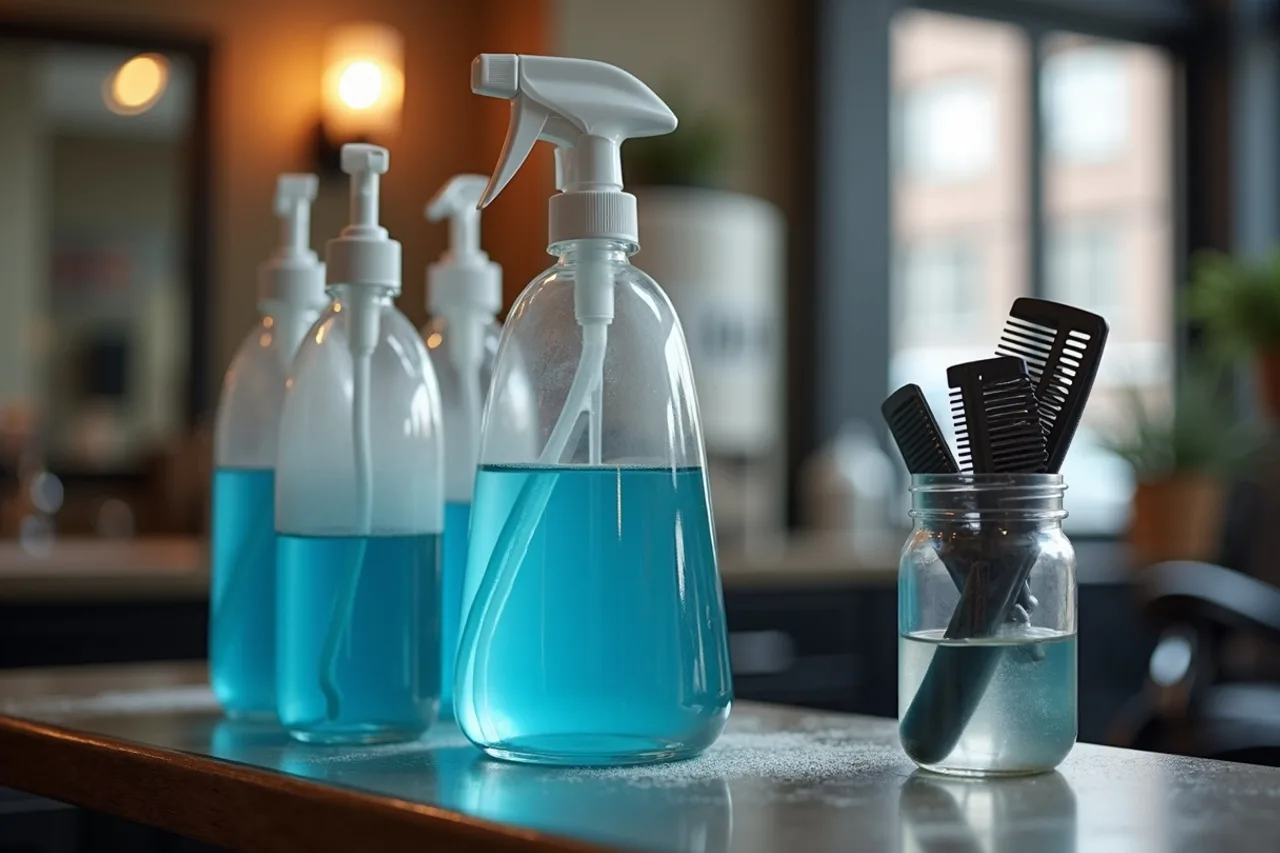
You're standing in a salon supply shop, looking at the shelf of liquids. Ten bottles, each one "professional", each one "effective", prices from 15 to 90 zł.
You're standing in a salon supply shop, looking at the shelf of liquids. Ten bottles, each one "professional", each one "effective", prices from 15 to 90 zł. You grab the cheapest, because "it's spirit anyway". Three weeks later an inspector asks whether your product has confirmed bactericidal, fungicidal and virucidal action – and you don't know what to say. Choosing disinfectants in a barbershop is not a price lottery. It is a decision that must be justified on the label and in the paperwork. This article shows how to choose consciously.
Three types of product – don't mix them up
In a barbershop you need products for three different uses. Using one for everything is the most common mistake:
- For hands (skin) – gentle, alcohol-based (min. 70%), with moisturising agents
- For surfaces – chair, worktop, mirrors; fast-acting, safe for upholstery
- For tools – clippers, scissors, combs; full-spectrum, allowing immersion
A hand product will not disinfect scissors. A tool product will ruin the skin of your hands. These have to be separate products.
Spectrum of action – what must be on the label
This is the most important criterion. The product must have a confirmed spectrum, that is, information on which microorganisms it acts against. Look for markings compliant with European standards:
| Marking | What it kills | Why it matters in a barbershop |
|---|---|---|
| B (bactericidal) | bacteria | the basics – skin, tools |
| F (fungicidal) | fungi, yeasts | risk of scalp ringworm |
| V (virucidal) | viruses | blood contact when shaving |
| Tbc / tuberculocidal | mycobacteria | for tools that contact blood |
For tools that make contact with blood (straight razor, clippers where there's a cut) the minimum is a B, F, V spectrum. A product that is "bactericidal only" is not enough.
A biocidal product with authorisation
Disinfectants are biocidal products. In Poland they must be entered in the register of biocidal products and hold a market authorisation issued by the Office for Registration of Medicinal Products, Medical Devices and Biocidal Products. This stems from the Polish Act of 9 October 2015 on biocidal products. The authorisation number is on the label – if it isn't there, it is not a legal disinfectant for professional use.
An inspector may ask for the product's safety data sheet. You must have it in the salon – the manufacturer makes it available for download or supplies it with the purchase.
Contact time and concentration – two parameters that decide
Even the best product won't work if you use it wrongly. Two numbers from the label you must follow:
- Contact time – how long the product must remain on the surface or tool (from 30 seconds to several minutes depending on the spectrum)
- Concentration – if the product is a concentrate, dilute it exactly per the manufacturer's table; "by eye" is a mistake
A shorter contact time often means a narrower spectrum. A product that kills bacteria in 30 seconds may need 5–15 minutes for fungi and viruses. Read the label to the end.
For soaking or for wiping
Tools such as combs and scissors are usually disinfected by immersion in a solution for the stated time. Surfaces – by spraying and wiping. Clippers, which cannot be immersed, are disinfected with a spray product intended for electrical equipment. Match the form of the product to the use – the same spectrum, a different application. We write about the workstation procedure itself in our article disinfecting the chair and surfaces – procedure.
How much to buy and for how much
An indicative starting budget for one workstation:
- hand product: 25–40 zł / litre
- surface product: 20–35 zł / litre
- tool product (concentrate): 40–80 zł / litre (lasts a long time after dilution)
- clipper spray: 30–50 zł
That is an outlay of around 150–200 zł to start. For comparison: a fine for missing or improper disinfection in the form of an on-the-spot penalty is usually 100–500 zł, and with more serious breaches the amounts rise. Skimping on products is a false economy.
Storing and handling products safely
Buying them is not the end. Disinfectants are chemicals that need to be stored sensibly:
- keep them in their original packaging with a legible label – don't pour them into unmarked bottles
- store concentrates out of reach of chance visitors and children
- label diluted solutions (name, concentration, date of preparation) – a solution loses effectiveness over time
- watch the expiry dates; an expired product may not work in the declared spectrum
Keep the safety data sheets of all products in a binder together with the rest of the documentation. It is these that tell you how to act in the event of a spill, or contact with skin or eyes – and an inspector may ask for them.
The most common mistakes when choosing products
Four traps that cost money or non-compliance:
- One liquid for everything – the same product for hands, surfaces and tools is a compromise that works nowhere
- Plain spirit on tools that contact blood – a narrower spectrum than the required B, F, V
- Ignoring the contact time – the most common mistake: spray and wipe off straight away
- No authorisation number on the label – you bought a "cleaning agent" instead of a biocidal product
Choosing a product is a decision you make once and apply every day. It is worth spending 15 minutes reading the labels rather than using something for a year that doesn't work the way you think. Once you have a good product, enter its name and concentration in the register – we show how in our article disinfection and sterilisation register – template. And how to fit the safety data sheets into the salon's overall paperwork is covered in our article barbershop sanitary documentation – a complete set for inspection.
Frequently asked questions
Is spirit enough to disinfect tools?
No. Spirit is mainly bactericidal, and for tools that make contact with blood you need a full bactericidal, fungicidal and virucidal spectrum (B, F, V). Use a product with a confirmed spectrum and a market authorisation as a biocidal product.
How do I know a product is legal for professional use?
The label must carry a market authorisation number for the biocidal product, issued by the Office for Registration of Medicinal Products, Medical Devices and Biocidal Products. You should also keep the product's safety data sheet in the salon.
Can one product serve for hands, surfaces and tools?
We advise against it. A hand product is gentle on the skin but too weak for tools. A tool product is too aggressive for the hands. Surfaces need a product that is safe for upholstery. These are three different products.
Why is contact time so important?
Because disinfection only takes place when the product stays on the surface or tool for the time stated on the label. Spraying and wiping immediately does not kill microorganisms. Different spectra require different contact times – for viruses usually longer than for bacteria.
A good product is half the battle – the other half is the procedure and the paperwork. BarberReady gives you ready-made disinfection instructions with product selection by spectrum, a place for safety data sheets and a disinfection register compliant with the requirements for hairdressing establishments. You buy consciously and have it documented.