Razor and Station Disinfection: The Procedure
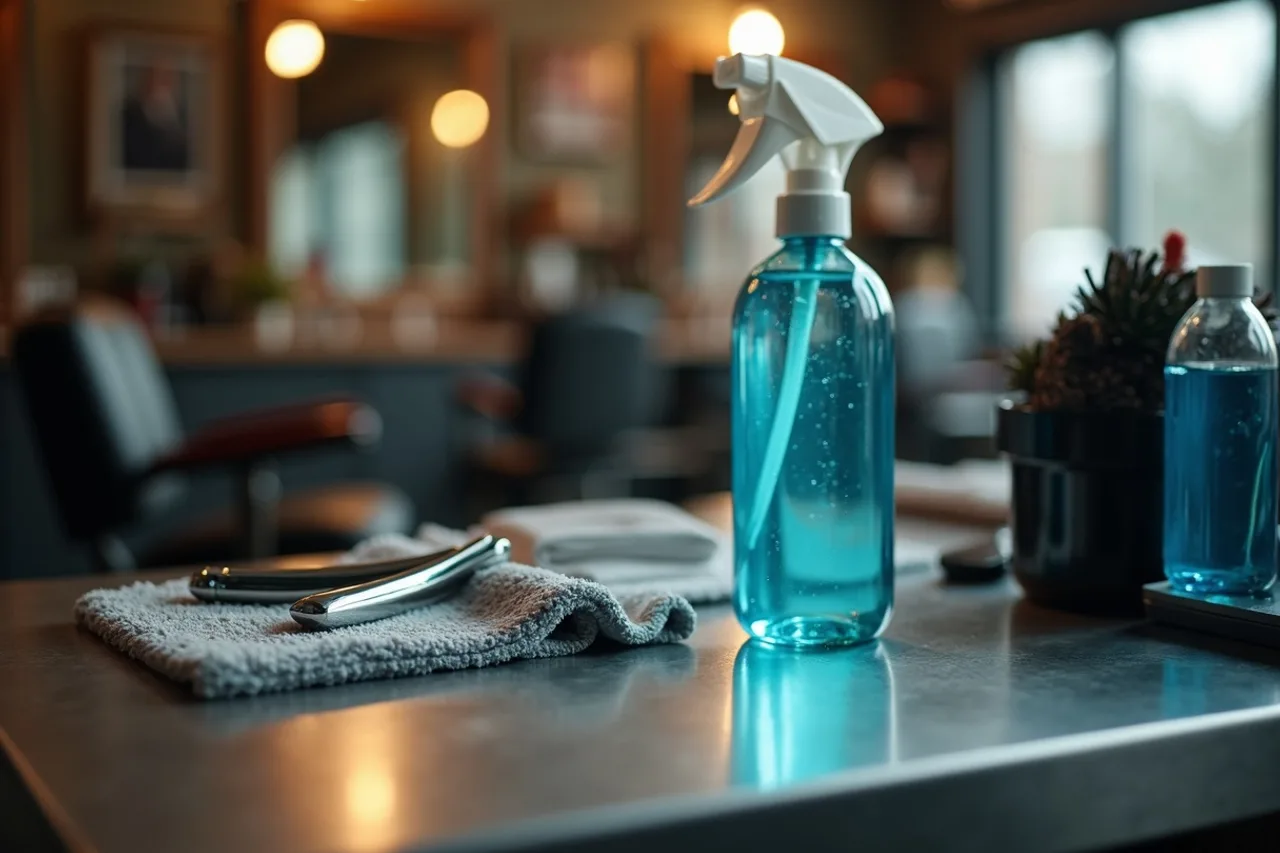
A customer gets up from the chair, a razor with a trace of foam lies on the counter, and the next customer is waiting at the door.
A customer gets up from the chair, a razor with a trace of foam lies on the counter, and the next customer is waiting at the door. It is tempting to shake off the razor, wipe the counter with a towel and invite the next guest. Yet this is the very moment that decides the customer's safety and whether you pass a Sanepid (the Polish sanitary inspectorate) inspection. Disinfecting the razor and the station between customers is not "good practice for the diligent" — it is an obligation stemming from the rules on preventing infections. This article gives you a ready procedure step by step: what to disinfect, with what and for how long, so you do it for real rather than for show.
Why the razor is a high-risk tool
The razor and blades contact the skin, and during a shave micro-cuts — often invisible — occur regularly. That means contact with blood, and therefore a real risk of transmitting infections (hepatitis B and C, other blood-borne pathogens) between customers. That is why the razor requires the strictest regime:
- the blade — ideally single-use, changed after every customer,
- the handle and reusable tools that break the skin — sterilisation (autoclave), which we write about in the article on tool sterilisation and the autoclave,
- the station — surface disinfection between customers.
Disinfection vs sterilisation — which applies to the razor
The key rule: anything that breaks the skin and contacts blood must be single-use or sterile. Liquid disinfection alone is not enough for a blade that contacts blood. So in practice:
| Element | Requirement |
|---|---|
| Razor blade | Single-use — changed after every customer |
| Razor handle (reusable) | Disinfection, and where there is blood contact — sterilisation |
| Station, counter, armrests | Surface disinfection between customers |
| Customer's skin after shaving | Disinfecting/soothing product on the micro-cuts |
The station disinfection procedure step by step
Between one customer and the next, carry out this sequence:
- Remove waste — the used blade into a closed sharps waste container, hair and single-use items into the bin.
- Clean mechanically — wipe off foam remnants, hair and dirt from the counter and chair.
- Disinfect the surfaces — spray or wipe the counter, armrests and backrest with a surface disinfectant.
- Observe the contact time — leave the product on the surface for the time specified by the manufacturer (usually 1–5 minutes). Do not wipe it off immediately.
- Disinfect your hands — with a hand-hygiene agent before serving the next customer.
- Prepare sterile/single-use tools — a new blade, a clean towel, sterile accessories.
The most common mistake is skipping point 4 — the contact time. A product wiped off immediately after spraying does not have time to work. Disinfection "dry in two seconds" looks good but protects no one.
What to disinfect with — choosing the product
Not every liquid is suitable for a salon. The product should:
- have an authorisation to market a biocidal product or medical device status,
- have a confirmed spectrum of action — bactericidal, fungicidal, virucidal (including against enveloped viruses, relevant for hepatitis),
- be intended for the right application — one for surfaces, another for tools, another for skin and hands,
- have a safety data sheet, which you keep in your documentation.
For the station you use a surface product, for the hands — a hand-hygiene agent, for the customer's skin — a product intended for skin. Mixing applications is a mistake the inspector will catch.
The register and documentation of disinfection
The inspector asks not only "do you disinfect", but "show me how it is documented". It is worth keeping:
- a written disinfection procedure — the same for the whole team,
- a disinfection and sterilisation register — kept up to date,
- safety data sheets for all products,
- an instruction on action after a cut to a customer or employee.
When every barber has the same procedure on the wall and in their head, the inspection stops being a lottery. We describe what the whole inspector's visit looks like in the article on the first 15 minutes of an inspection.
What to do if you cut a customer
Cuts happen during a razor shave. What matters is having a ready scheme:
- stop the procedure and put on gloves if you are not already wearing them,
- stem the bleeding with sterile material,
- disinfect the cut with a skin product,
- put the used blade and blood-contaminated materials into the sharps/contaminated waste container,
- disinfect the station and replace the tools with new/sterile ones,
- record the incident if the procedure requires it.
The most common disinfection mistakes
Disinfection done "by eye" gives an illusion of safety. Here are the mistakes that come out during inspections and after customer complaints:
- Wiping the product off immediately — skipping the contact time means the agent does not have time to work.
- One product for everything — a different agent for surfaces, another for tools, another for skin and hands. Mixing applications is a mistake.
- Disinfection without prior cleaning — hair and foam remnants block the product's action.
- Treating a UV cabinet as disinfection — UV serves to store clean tools, not to decontaminate them.
- No safety data sheet for the product in the establishment's documentation.
Each of these mistakes is simple to fix when the salon has one written procedure that the whole team follows.
How to set up the station so that disinfection is feasible
A procedure only works if it can be carried out at the pace of work. That is why the station should have a permanent kit at hand:
- a surface disinfectant and a separate one for tools,
- a hand-hygiene agent and a skin disinfectant for the customer,
- sterile dressing materials in case of a cut,
- a closed sharps waste container within reach,
- a place for clean tools, separated from those awaiting disinfection.
When everything is in place, the barber does not have to choose between speed and hygiene. A product tucked away in the back or a missing hand agent is the simplest way for disinfection to stay only on paper.
Frequently asked questions
Can I disinfect the razor and use it on the next customer?
A blade that contacts blood should be single-use — you change it after every customer. The reusable handle requires disinfection, and where there is blood contact, sterilisation. Liquid disinfection alone does not replace changing the blade.
How long should I leave the product on the station before wiping?
As long as the manufacturer states on the label — usually 1 to 5 minutes. This is the so-called contact time, without which disinfection is not effective. Do not wipe the product off immediately after spraying.
Are pre-soaked wipes enough to disinfect the station?
They can be, provided they are intended for surface disinfection, have a confirmed spectrum of action and you observe the contact time. Ordinary moist wipes are not a disinfectant.
Which product should I choose so it passes an inspection?
One with an authorisation to market a biocidal product or medical device status, with a spectrum covering bacteria, fungi and enveloped viruses, and a safety data sheet in the establishment's documentation.
A ready disinfection procedure for the whole team
Disinfection only works when everyone does it the same way. The ready-made BarberReady sanitary documentation includes a razor and station disinfection procedure, a register, an instruction on action after a cut and product data sheets — written in a barber's language, not a lawyer's. Prices from PLN 299.