Disinfecting Clippers and Scissors in a Barbershop
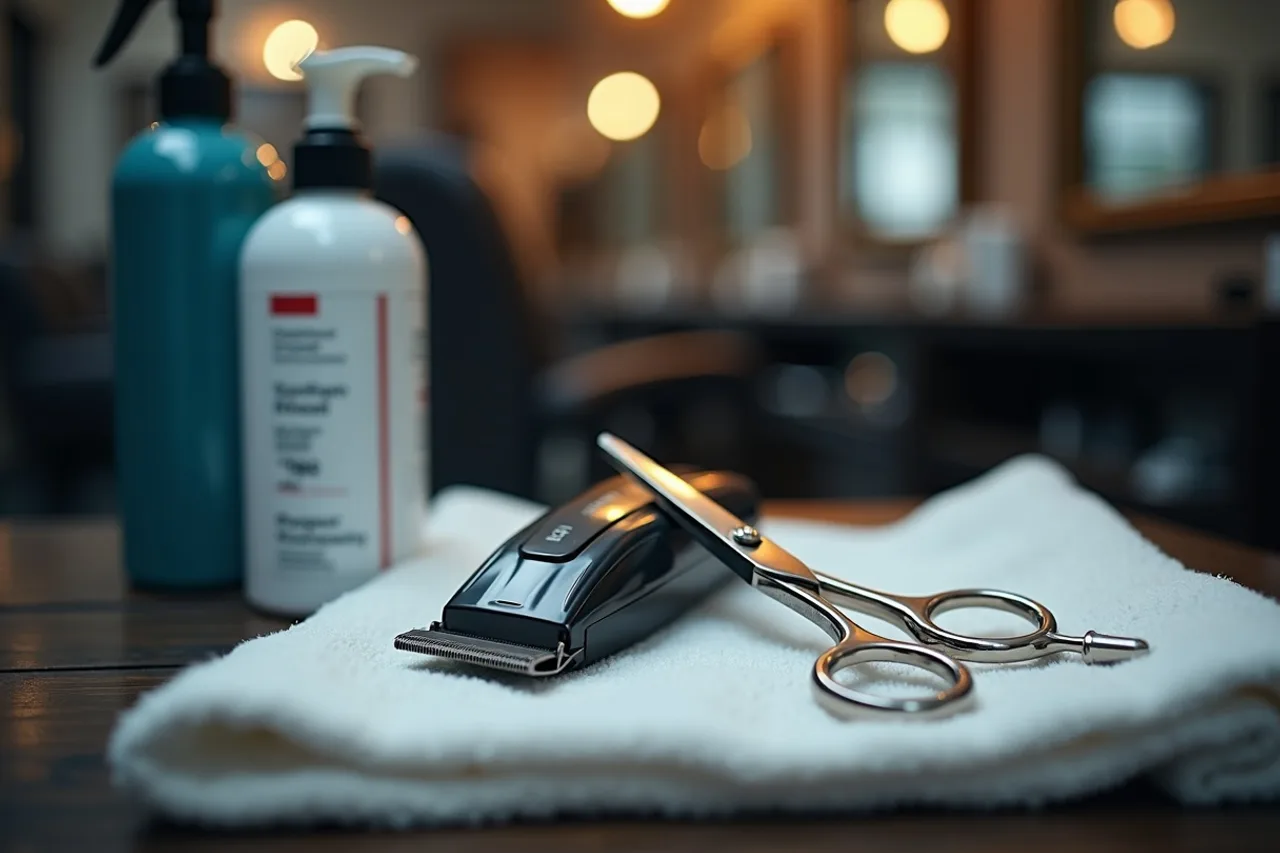
A trimmer, fade clippers, scissors, a comb — dozens of tools pass through a barber's hands each day, and every one of them touches the skin and hair of successive…
A trimmer, fade clippers, scissors, a comb — dozens of tools pass through a barber's hands each day, and every one of them touches the skin and hair of successive customers. "It's just a haircut, there's no blood" — you hear it often. The trouble is that clippers press into the skin during a fade, scissors cut by the ear, and a comb travels across a scalp with dandruff, ringworm or inflammation. Disinfecting cutting tools is not a formality — it is a barrier to infection and a standard point of a Sanepid (the Polish sanitary inspectorate) inspection. This article gives you a procedure for disinfecting clippers, blades and scissors step by step.
Why clippers and scissors require disinfection
Even without visible blood, cutting tools carry micro-organisms:
- scalp ringworm — transmitted by combs and blades,
- bacteria from skin with minor lesions, acne or folliculitis,
- blood — during a fade and "zero" work, the clippers regularly catch the skin, causing micro-damage.
That is why the rule is clear: you disinfect tools between customers, and those that break the skin barrier must be single-use or sterile. On the strictest regime for blades, we write in the article on tool sterilisation and the autoclave. It is worth remembering that the customer does not see bacteria or fungi — but they do see whether you reach for freshly disinfected clippers or the same ones you just used on someone else. Disinfection is therefore not only a sanitary obligation but also part of the trust on which a barbershop builds its regulars.
Classifying tools by risk level
You do not disinfect everything the same way. Let us organise it:
| Tool | Contact | Requirement |
|---|---|---|
| Comb, brush | Skin, hair | Disinfection between customers |
| Clippers/trimmer (body) | Skin, hair | Surface and blade disinfection |
| Clipper blade during a fade | Possible blood contact | Disinfection; sterilisation if it broke the skin |
| Scissors cutting near the skin | Possible blood contact | Disinfection; sterilisation on blood contact |
| Razor blade | Blood contact | Single-use |
Disinfecting clippers and trimmers — step by step
Clippers are the tool easiest to neglect, because they "run all day". The correct procedure between customers:
- Clean mechanically — remove hair from the blade with a brush, take the blade off if needed.
- Degrease and clean the blade — hair and sebum remnants hinder disinfection.
- Disinfect the blade — spray it with a tool disinfectant or use a spray agent intended for blades.
- Observe the contact time — leave the product on for the time stated by the manufacturer (usually a few minutes).
- Wipe the body — disinfect the clipper housing with a surface agent.
- Oil the blade — after disinfection, as the manufacturer recommends, so it does not corrode.
The most common mistake: "disinfection" with a cooling spray for the blade (of the 4-in-1 type) with no confirmed biocidal action. Such a spray cools and lubricates but does not replace a disinfectant if it lacks the appropriate status.
Disinfecting scissors
Scissors cutting near the skin (at the ear, the neck) can come into contact with blood. The procedure:
- remove hair and dirt from the blades,
- disinfect with a tool product, observing the contact time,
- where blood contact is suspected — subject them to sterilisation,
- dry and store in a clean, closed place,
- periodically maintain the pivot so disinfection does not damage the mechanism.
Scissors tend to rust from aggressive products — choose an agent compatible with the material and keep up maintenance so the tool serves for years.
Combs and accessories
Combs and brushes travel across every customer's scalp, so they too require disinfection:
- clean off hair,
- immerse or spray with a disinfectant, observing the contact time,
- rinse (if the product manufacturer requires it) and dry,
- store clean accessories apart from dirty ones.
A UV cabinet is a place to store already-disinfected tools — it does not replace disinfection. This is a common mistake caught during an inspection.
What to watch to pass an inspection
The inspector checks the consistency between procedure, practice and documentation. Take care of:
- one procedure for the whole team — so every barber disinfects the same way,
- products with safety data sheets and a confirmed spectrum of action,
- a disinfection register kept up to date,
- separation of clean and dirty tools at the station.
When every employee answers "how do you disinfect the clippers" the same way, the inspection stops being a lottery. We describe what the whole visit looks like in the article on the first 15 minutes of an inspection.
Frequency and organisation of work
The greatest enemy of disinfection is not a lack of knowledge but the pace of work. With a full schedule, a barber is tempted to "sort it out later". That is why disinfection has to be woven into the rhythm of serving customers rather than treated as a separate end-of-day task:
- between customers — disinfect the clipper blade, scissors and comb used on the previous guest,
- after a procedure with blood — immediate disinfection, and for tools that break the skin, sterilisation,
- at the end of the day — thorough cleaning, maintenance and oiling of the blades,
- periodically — check the condition of the tools and replace worn blades.
It is worth having two containers at each station: one for clean tools ready to use, the other for those "for disinfection". This simple division eliminates the risk of reaching for a dirty tool in a hurry and is immediately visible to the inspector as part of the system.
The station kit — minimum equipment
For disinfection to be feasible at the pace of work, every station should have a permanent kit at hand:
- a tool disinfectant (with a safety data sheet in the documentation),
- a surface disinfectant,
- a hand-hygiene agent,
- a brush for removing hair from the blades,
- oil for blade maintenance,
- a sharps waste container within reach,
- two containers: for clean tools and for those awaiting disinfection.
When everything is in place, the barber does not have to choose between speed and hygiene — they do both. A missing hand agent or a product tucked away somewhere in the back is the simplest way for the procedure to stay on paper.
Frequently asked questions
Does a cooling spray for clippers disinfect the blade?
Not always. Products of the 4-in-1 type cool, clean and lubricate, but they only disinfect if they have a confirmed biocidal action. If the manufacturer does not declare such action, you need a separate disinfectant.
Do I have to disinfect tools after every customer?
Yes. You disinfect clippers, scissors and combs between customers because they contact the skin and hair. Tools that break the skin barrier must additionally be single-use or sterile.
Is a UV cabinet enough instead of disinfection?
No. A UV cabinet and lamp serve to store already-disinfected tools, not to disinfect them. Treating it as disinfection is a mistake the inspector will catch.
How do I protect scissors from rust with frequent disinfection?
Choose a product compatible with the tool's material, dry the blades thoroughly after disinfection and maintain the pivot regularly. This way disinfection does not shorten the scissors' lifespan.
One procedure for the whole team
Tool disinfection only works when every barber does it identically. The ready-made BarberReady sanitary documentation includes a procedure for disinfecting clippers, scissors and accessories, a register and station instructions — written in a barber's language. Prices from PLN 299.